

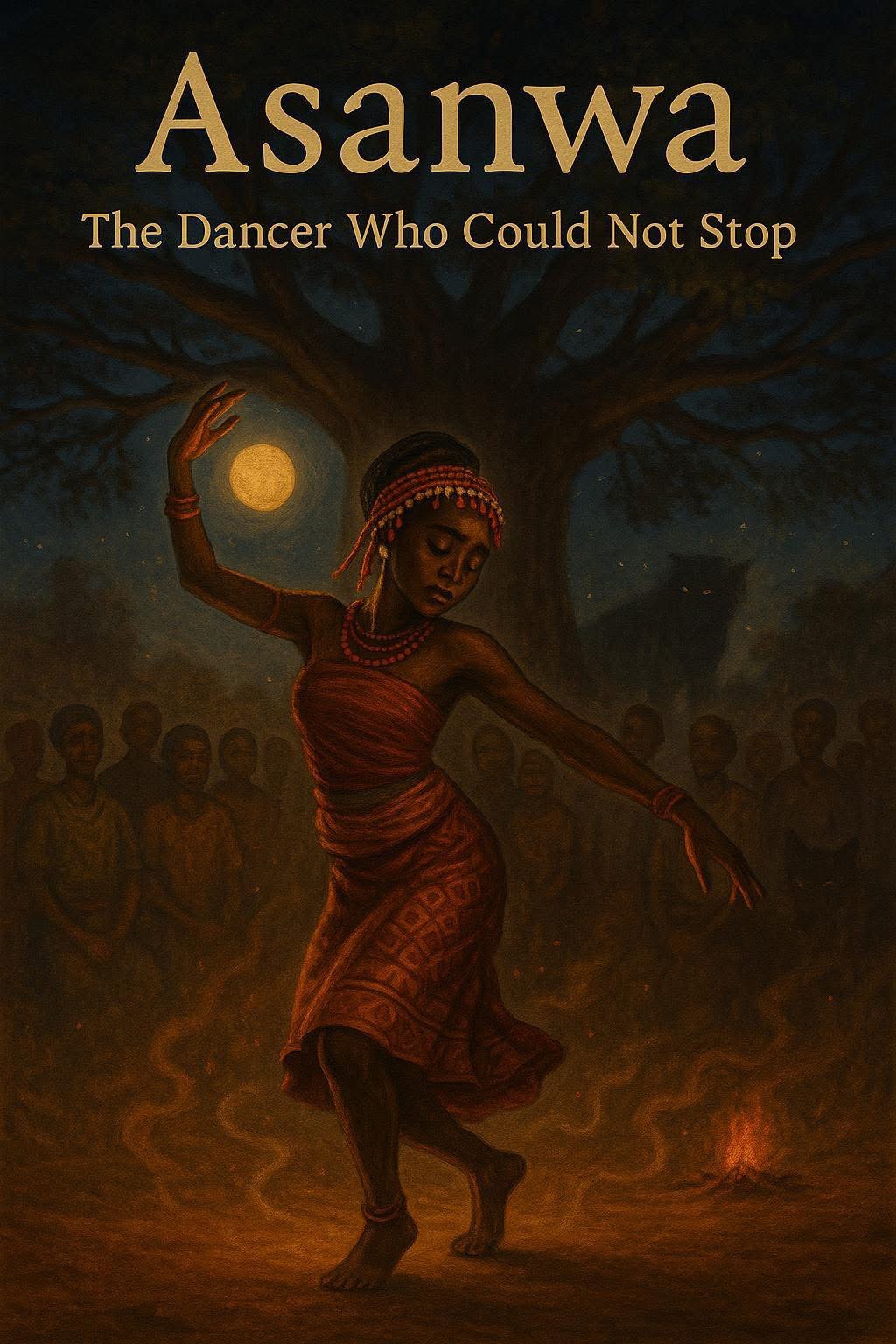
Asanwa: The Dancer
—- – – —-
This is folktale whispered beneath the iroko, where old spirits lean in to listen.
It is the story of Asanwa, the beautiful village dancer of Ibekwu, whose steps once turned sorrow to laughter and dust to rhythm.
It is a story about the one who danced not just with her feet, but with her soul—
and gave too much of herself to a world that forgot to give back.
It is a story about joy that becomes a burden…and grace that vanishes when it burns too long in the firelight.
Come with me ;
Asanwa was born in the middle of the harvest moon, her first cry timed to the rhythm of distant drums.
The priestesses told her mother that Anyanwu, the spirit of motion, had brushed the infant beauty’s brow.
Her name, Asanwa, meant “Graceful daughter of beauty.” And true to it, she moved like a river remembering its path.
By age ten, she no longer walked—she glided. She no longer stepped—she spoke with her heels.
Asanwa walked gracefully and danced like a silk scarf in slow motion, graceful, deliberate, and sensuous. Each movement , a celebration of the creator’s ingenuity.
“Asanwa, Omalicha! The girl carries the rhythm of the ancestors in her bones,” whispered the old village drummers.
“Even the iroko leans to hear her steps,” said Adanna, the female herberlist, half-laughing.
When Asanwa danced, hearts softened. Rain came in the dry season. Laughter bloomed at festivals. Infants cooed in sleep.
The people praised her. They called for her and told her they needed her.
And she danced because when she danced, she was loved. Or so she thought.
But every blessing has a shadow.
Each time Asanwa danced, a little of her life-water slipped through her soles and into the earth. No one saw it.
But he did. A creature watched from the tall grass. Its eyes glowed like a bonfire, and its grin cracked like splitting wood. It was the Hyena of Hunger.
He was ancient. Some said he had once been a child of Ibekwu. Like her, he was praised too often, used too long, and left to die of hunger when he could no longer run errands. Now, he fed on the exhaustion of those who gave until there was nothing left.
No one in the village dared speak his name, but the griots remembered. Mama Adanna, the old priestess, once whispered to those who flocked to her temple to share in the free palm wine of the gods: “Something feeds on our joy. Something laughs when the gifted are not protected. ” They dismissed her wise nuggets as the soliloquy of a lonely old woman.
The Hyena stayed put, lurking in the tall grasses. Only Asanwa saw him. She saw him only when she tried to rest.
“Dance, little flame,” he would whisper.
“You are loved for what you give. If you stop, they will forget you,” he would cajole her. She believed him.
Asanwa’s fame grew. But so did the pain in her bones. Her feet bled. Her smile began to wane.
Sometimes she rested beneath the iroko tree. The Hyena would watch her from the bush of tall grasses, licking its teeth.
One morning, her mother found her there, pale and burning with fever. “You need not go out today,” her mother said gently.
“Let them wait. Even the sun rests.”
Asanwa shook her head. “They’re waiting. Today is the naming of Chief Ncheke ‘s grandchild. I must bring sweet music and joy to the guests.”
Her mother held her two hands. “Let them find joy somewhere else. You should find joy in your silence for once. Rest your feet, stay silent, nourish your body. Let them remember you’re a daughter, a young woman, not a drum. Even the gods do not dance every day.”
Before she could answer, a small girl appeared, tear-streaked.“Asanwa,” she cried, “Papa hasn’t smiled since the naming ceremony began. ” The guests are also restless; they are asking for you. Only your dancing will make the naming ceremony a success.”
Asanwa looked into the child’s eyes. She stood and left to answer the call of duty, to sing and make people merry.
And once again, she danced. The Hyena’s grin grew wider.
At the Great Ibekwu Festival of the Moon, the village gathered. The stars watched. The drums waited.
Weary but determined, Asanwa tied a fresh wrapper around her waist. Then, she put ude aki-palm kernel oil- on her skin to make it glow. Her skin glittered, but her eyes were hollow. Her mother wept softly.
“Are you sure, my daughter?” she asked. “I would rather have you whole than have them happy.”
Asanwa kissed her hands.
“If I stop, they will forget. But if I continue … they will remember.”
And then she walked off the family compound and into the dance circle at the village square.
The drums began. The torches blazed. The villagers clapped in ecstasy and sang:
“Asanwa!
Here she comes
Dancer of joy!
Here she comes
Flame of the people!”
Here she comes.
She danced, and the villagers sang. Asanwa raised both arms to the moon. Her feet moved like memory, but her breath came sharp, like thorns.
A boy tugged at his father’s sleeve. “Nnam,… she looks tired. Why don’t they tell her to stop?”
His father lowered his gaze.
“Because people love to be fed. We love what feeds us. But we don’t always notice when it is drying up and dying.”
The young boy, Opara, shook his head and looked away from the dance arena.
The dance went on far into the night until firelight flickered. Asanwa’s feet grew heavy.
The drums slowed. The torches sputtered.
Then, without warning, she collapsed. Her wrapper fluttered like flames, and Asanwa collapsed like a sand castle.
The Hyena of Hunger rose, bowed toward her still form, and disappeared into the dust.
The villagers pressed forward. The drummers dropped their sticks. Silence wrapped the night.
Asanwa did not move.
Only the wind moved, rising, circling, rustling the earth.
That night, the iroko did not sleep.
And the drums fell silent.
They buried her beneath the iroko, where she once rested and laughed with children.
No statue was built, no song was sung, and the Ibekwu village moved on, but not everyone forgot.
A week later, Opara, the boy from the crowd, returned with a stone. With trembling fingers, he carved:
“Let her rest.
Let us remember when giving stops.”
He placed it at the base of the tree. And something changed in Ibekwu. Whenever a dancer seemed tired, the people no longer clapped to urge them on.
Instead, they offered the dancer a seat beneath the iroko. A calabash of cool water to wet their parched throats, and fresh shea butter for her feet.
Adanna would say; Care is louder than clapping. And gratitude should bring comfort.
A festival was instituted to remember Asanwa. On the day of the festival, children gather beneath the tree.
They tell her story. They watch each other’s feet. And they remember.
Moral
When you love someone for what they give, be sure you do not take everything.
Even the brightest spirit must rest before it fades.
Joy should come from balance.
The giver should know when to stop
When to self-nourish
And the taker;
Learn to give rest to the giver.
Give nourishment.
Give back.
Remember Asanwa, the dancer who could not stop.
Not because she loved to dance…
But because she was never allowed to.😢




Discussion about this post